The Space Between the Forms
Place Eclipse I beside Eclipse II and the eye does not settle on either sculpture for long. It moves from one polished contour to the other, across the interval that separates them and into the reflections gathered on their surfaces. The composition is made from two objects, but it is completed by something less tangible: the space they hold between them.
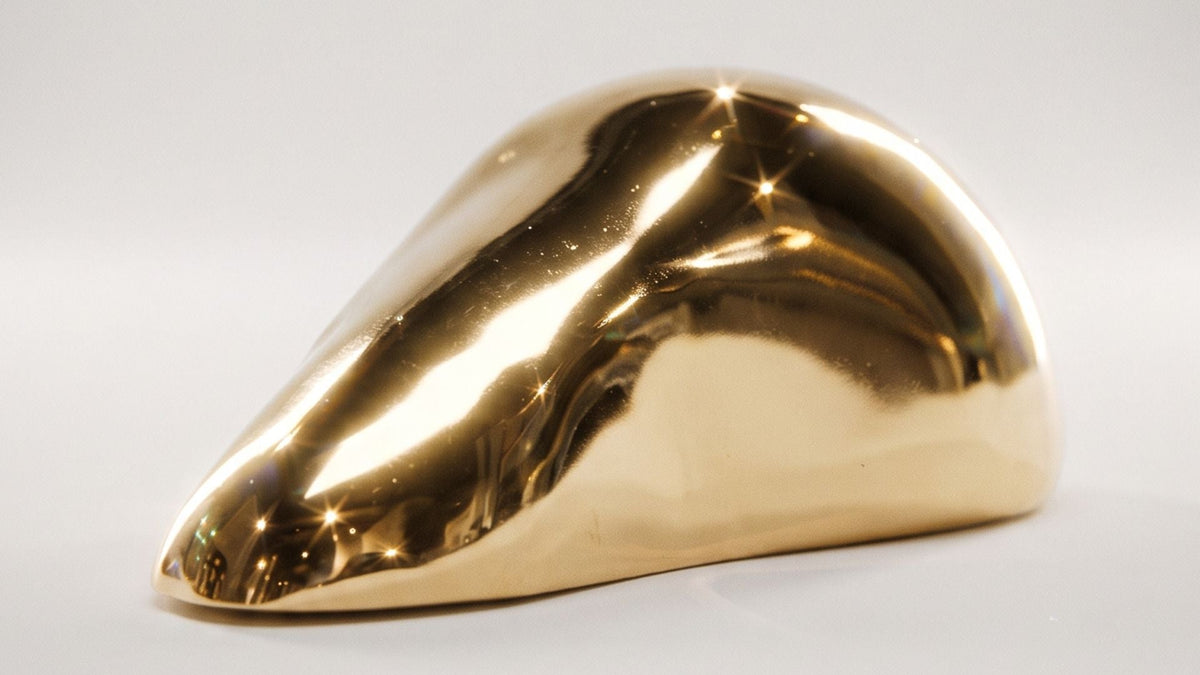
The sculptures take their cue from river pebbles, forms produced through movement rather than drawn in a single decisive gesture. Water, friction and time soften the edges of a stone until its history is no longer recorded as a sequence of events, but as a contour. Eclipse retains that sense of gradual formation. Its curves appear resolved without becoming geometric, and familiar without reproducing any particular stone.
From River Stone to Reflective Surface

The transition from pebble to polished brass changes the meaning of the form. A river stone usually absorbs light or returns it softly. Eclipse does the opposite. Its surface catches whatever surrounds it and bends those images around a convex body. A window becomes a bright passage; a darker object appears as a moving shadow; the person approaching the sculpture enters its surface as a fleeting reflection.
This responsiveness prevents the pieces from reading as sealed, self-contained objects. Their contours may be fixed, but their appearance is conditional. Daylight, neighbouring materials and the position of the viewer continually alter what can be seen. Polished brass is therefore more than a decorative finish here. It allows the room to participate in the work.
That exchange also introduces a useful tension. The softened profile belongs to the natural world, while the precision of the reflective surface makes the object feel deliberately made. Eclipse does not attempt to imitate a pebble convincingly. It takes the memory of a water-worn form and gives it a different visual behaviour.
The Difference Between Two

Eclipse I measures 200 millimetres in length; Eclipse II extends to 260 millimetres. The difference is modest enough for the pieces to share a language, yet pronounced enough to avoid simple duplication. Seen together, one does not function as a miniature of the other. Each has its own weight, profile and orientation within the composition.
Their low silhouettes also resist a single, privileged viewpoint. Seen from above, the broad planes of polished brass make the resemblance to water-worn stones most apparent. At eye level, the pieces become slimmer and more elusive, their upper curves rising only slightly from the surface beneath them. Moving around them reveals that their apparent simplicity depends on a contour that is continuously changing.
An Object That Includes Its Surroundings

Because Eclipse reflects rather than merely occupies its setting, the choice of surroundings matters. On pale stone, its outline is sharply defined while the gold surface gathers cooler fragments of the room. Among books, glass or darker woods, those colours enter the brass and complicate it. The piece does not remain one unbroken gold tone; it becomes a condensed, curved image of where it has been placed.
Living with the sculptures therefore involves a small degree of authorship. They may be shown individually, but together they invite continued adjustment: brought into conversation, separated, or turned to receive a different part of the room. Their natural reference gives them an immediate clarity. Their reflectivity makes that clarity unstable in the most interesting way.