Design Agenda October
What Five Fairs Revealed About Collecting, Discovery and the Contemporary Interior
For one week in October, the design world could be measured in two kinds of distance. In North Carolina, High Point Market spread across more than 11.5 million square feet of showroom space. In Paris, four fairs unfolded within the same city, close enough to visit in succession but different enough to propose competing ideas about what deserves attention.
One setting asked what might enter the home next. The others considered what we collect, which histories receive another look, and how a fair can make room for voices that larger institutions have often overlooked. Taken together, the five events made October less a parade of newness than a study in selection: of furniture, artworks, materials, galleries and points of view.
High Point Market

High Point is not designed for the casual glance. From 17 to 21 October, its scale required buyers and designers to move through furniture, lighting, textiles and accessories as parts of a complete interior rather than isolated categories. That breadth is the fair’s practical strength. It reveals not only individual launches, but the commercial decisions that will shape rooms long after the showrooms close.
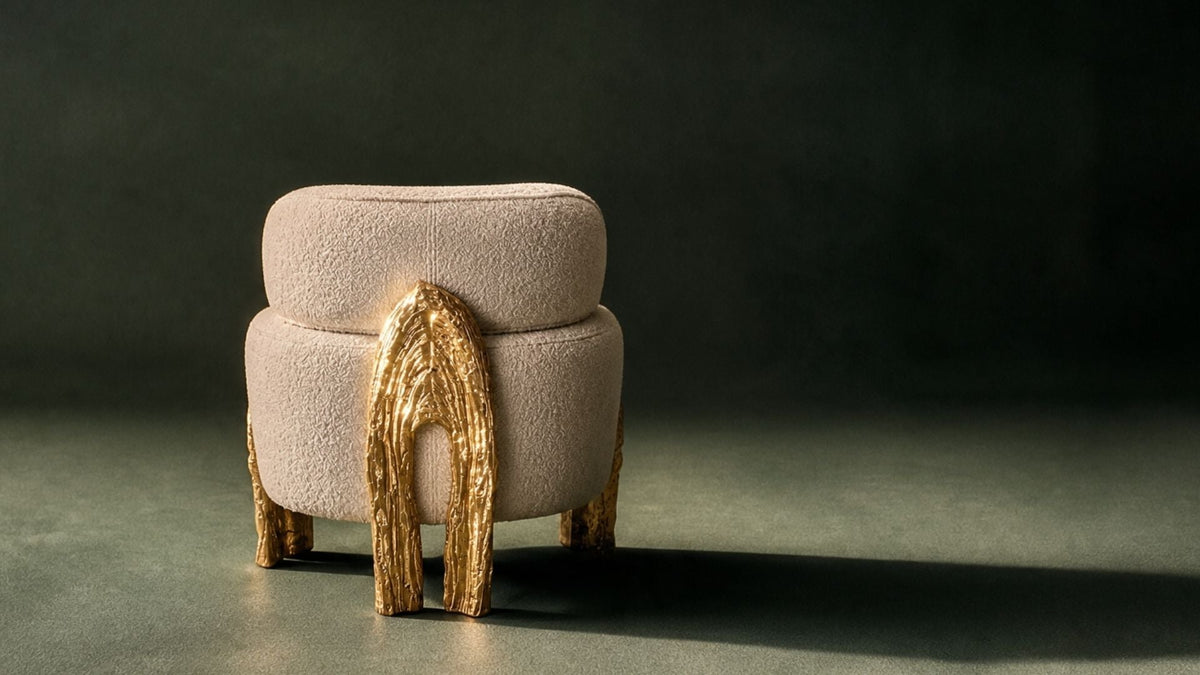
The more interesting direction this season was not a single colour or silhouette. It was a renewed appetite for rooms that feel assembled over time. Reporting from the market noted burlwood, darker blues and greens, aged finishes and visible handwork. Familiar forms returned with greater material character, while lighting makers described buyers looking for a cohesive whole-home proposition. The emphasis was less on an object announcing its novelty and more on how convincingly it could live beside everything else.
That distinction matters. Trends pass quickly when they depend on instant recognition. A room built through contrast, provenance and considered combinations can keep changing as its owner adds to it. High Point’s vastness ultimately offered a useful reminder: decorating is not the act of finding one perfect piece, but of understanding the relationships between many of them.
Design Miami Paris

Design Miami Paris 2026, Hôtel de Maisons. Image: Design Miami.
A fair becomes more compelling when its setting begins to argue with the work. At Design Miami Paris, the 18th-century Hôtel de Maisons did exactly that. Furniture and objects occupied its rooms, courtyard and garden, placing approximately 140 years of design inside an architecture already dense with history.
The strongest presentations used that context rather than competing with it. Pierre Renart’s Arabesque, a monumental outdoor bench formed from a 17-metre ribbon of moabi wood, followed a continuous curve through the garden and received the fair’s Best Design at Large award. Salon 94 Design brought Alberto and Diego Giacometti into conversation with Rick Owens, Peter Schlesinger, Urs Fischer and F. Taylor Colantonio. Elsewhere, a Frank Lloyd Wright chair was recognised as the best historic work, while Mathias Bengtsson’s Membrane Chair from 2026 received the contemporary award.
The distinctions between historic and contemporary work remained visible, but they did not become barriers. This was the fair’s most persuasive idea: collecting can connect periods without flattening their differences. A new chair need not imitate an older one to belong in the same room. The dialogue comes through proportion, material, humour or the collector’s own way of seeing.
Paris Internationale

Paris Internationale took the opposite approach to monumental scale. For its 12th edition, the fair moved to Quai de Valmy and deliberately adopted a more focused format. Emerging and established galleries were intermingled rather than separated into hierarchical sectors, allowing discovery to happen through proximity.
Its new collaborations widened that proposition. Second Nature brought seven emerging Korean galleries and sixteen artistic positions into a shared exhibition, tracing connections between vernacular techniques, ritual, technology and contemporary image culture. Ayman Zedani’s In the Bellies of the Rocks, presented with Arts AlUla and its partners, added an immersive meditation on landscapes and systems that exceed immediate human perception.
What Paris Internationale offered was time: not an absence of ambition, but enough space for a presentation to establish its own logic. In a crowded art week, that restraint became a form of confidence. Discovery depended less on finding the loudest booth than on noticing an unfamiliar gallery, following a material connection or staying with a work that resisted an immediate conclusion.
Art Basel Paris

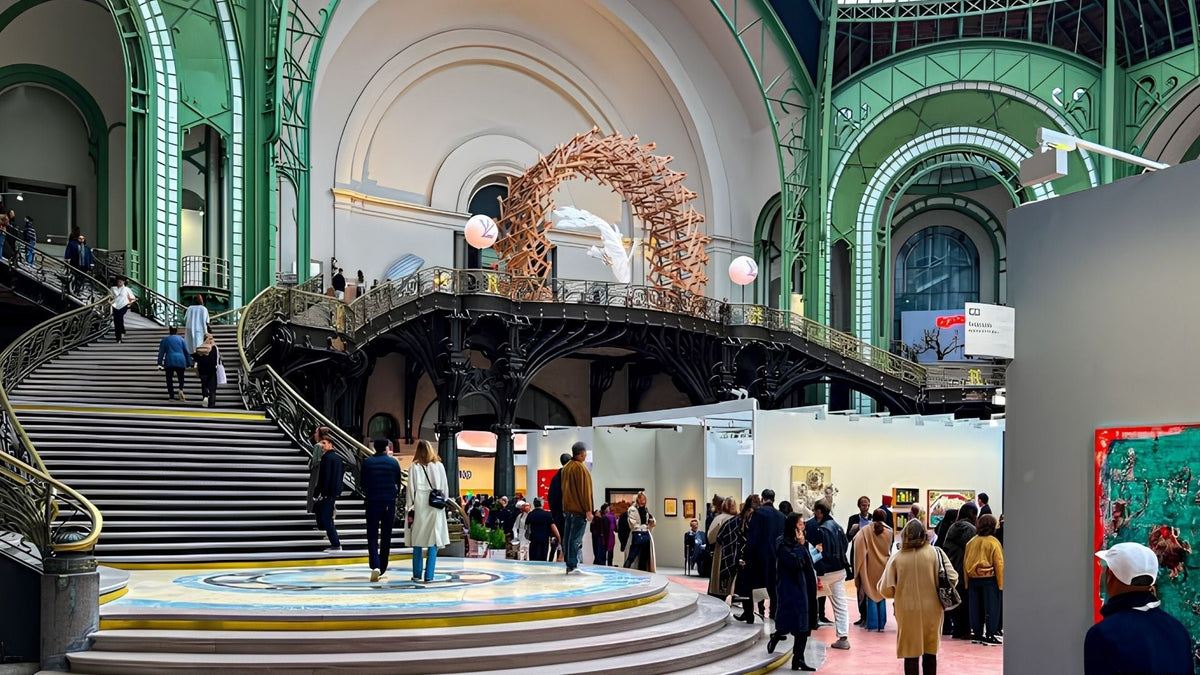
Art Basel Paris 2026, Grand Palais. Image: Galerie Karsten Greve.
At the Grand Palais, Art Basel Paris carried the weight of an international institution. Its 2026 edition assembled more than 200 exhibitors, but two smaller sectors gave the fair much of its intellectual range. Emergence presented sixteen solo booths devoted to younger practices. Premise expanded to twelve presentations and allowed work made before 1900, creating space for histories that do not fit neatly within the usual modern and contemporary chronology.
That structure made room for sharp juxtapositions: new commissions alongside overlooked postwar figures, digital culture beside works on paper, and artists entering the fair for the first time beside established programmes. It suggested that relevance is not synonymous with recency. Sometimes the most contemporary gesture is to return to an artist or period that the accepted canon has left at its edges.
The fair was scheduled to continue until 25 October, but organisers closed it on Friday evening amid concerns about unrest in Paris. The shortened public run became an unavoidable part of this edition’s history. Yet the curatorial proposition remained clear: a major fair can use its scale not only to confirm value, but also to complicate how that value has been assigned.
Menart Fair

Menart Fair gave the week its most direct question: Where Is Home? Across 34 galleries from 18 countries, artists from the Middle East, North Africa and their diasporas approached home as language, memory, territory, faith and inheritance rather than a fixed address.
The Algeria Project Room made that question particularly specific. Curated by Wassyla Tamzali, it brought together emerging artists connected to Les Ateliers Sauvages, an independent art centre in Algiers. Their work grew from different experiences, but the presentation located artistic practice within colonial and postcolonial history, collective memory, the civil war of the 1990s and the continuing search for a place in which to work freely.
Here, geography was not a label attached to a booth. It was part of the conditions under which the work had been made. That difference gave Menart a necessary place within the Paris circuit. It asked visitors to consider not only where an object might belong, but what belonging means for the person who created it.
What October Left Behind
Across these five fairs, the most memorable propositions did not offer a single forecast for the contemporary interior. They offered better ways to look. High Point showed the home as an evolving composition. Design Miami Paris placed generations of design in conversation. Paris Internationale protected the conditions for discovery. Art Basel reopened the canon, while Menart made belonging itself a subject.

For a collector, that range is more useful than a list of trends. It shifts attention from acquisition alone to context: why one work speaks to another, which histories enter a room, and what we learn by living with perspectives beyond our own. The October agenda was crowded. Its real value lay in learning where to pause.