


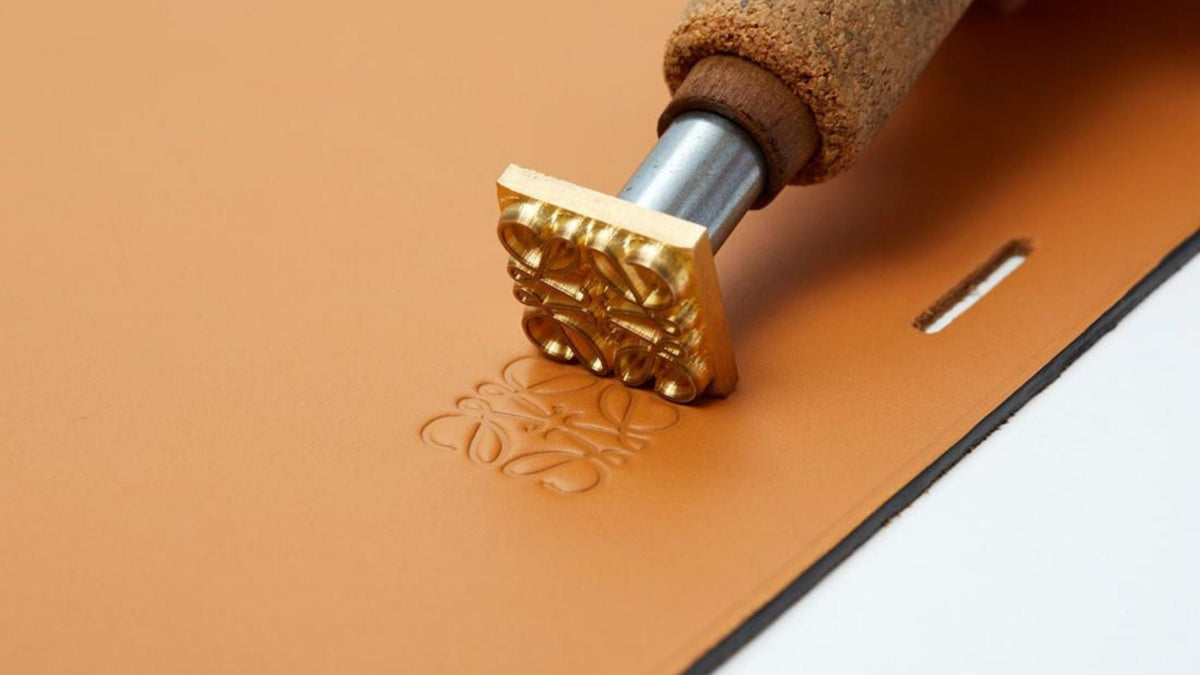
How LOEWE Turned Craft Into Culture
Craft has always been part of LOEWE’s DNA. Founded in Madrid in 1846 as a collective of leather artisans, the house built its identity around the intelligence of the hand, material knowledge, patience, precision, and the ability to transform something raw into something extraordinary.
But LOEWE did something more ambitious than simply preserving its craft heritage.
It made craft cultural.
Rather than treating craftsmanship as a production technique hidden behind the finished object, LOEWE placed the maker, the process and the material at the centre of the conversation. Craft became something to exhibit, collect, discuss and experience, as relevant to contemporary culture as fashion, art or design.
From technique to artistic language

The distinction is important.
Craft can be understood as how something is made. Culture asks a larger question: what does making mean to us?
LOEWE's approach has increasingly moved beyond technical excellence towards artistic expression. Its Craft Prize, established in 2016, was conceived to recognise excellence, innovation and artistic vision in contemporary craftsmanship.
The prize does not simply celebrate traditional techniques. It looks for makers who reinterpret them.
Ceramics become sculpture. Weaving moves into unexpected materials. Traditional processes are combined with contemporary forms. Ordinary materials acquire new significance.
The result is craft that feels neither nostalgic nor purely functional. It feels alive.
The Craft Prize changed the conversation

The LOEWE FOUNDATION Craft Prize is perhaps the clearest expression of this philosophy.
Now an established international platform, the prize brings together makers working across ceramics, wood, textiles, glass, metal, jewellery, paper, furniture and other disciplines. Its 2025 edition received more than 4,600 submissions from artisans representing 133 countries and regions, with 30 finalists selected from 18 countries and regions. That scale matters.
It suggests that contemporary craft is not a niche category. It is a global creative language.
The exhibitions make this even clearer. Rather than presenting craft as something belonging to a historical museum, LOEWE places contemporary works in carefully considered exhibition environments where they can be encountered as art.
The object is given space. The material is given silence. The hand is given attention. And suddenly, something made by hand is no longer simply handmade. It becomes something to contemplate.
Making the invisible visible

Luxury has traditionally been associated with perfection.
LOEWE has helped shift the conversation towards something more nuanced: the value of the human hand.
A handmade object carries evidence of its making. Slight irregularities, variations in texture, traces of pressure and changes in material become part of its identity.
The imperfection is not necessarily a flaw. It is proof of authorship.
This idea is especially powerful in a world increasingly dominated by digital production and industrial repetition. When almost anything can be reproduced, the unique becomes more valuable.
The hand becomes a signature.
Craft as a cultural bridge

Perhaps the most important thing LOEWE has achieved is to remove craft from a hierarchy.
It has placed the craftsperson alongside designers, artists, architects and curators — creating a dialogue rather than a distinction between disciplines.
The Craft Prize jury has included figures from design, architecture and museum culture, reinforcing the idea that contemporary craft belongs within a much broader cultural conversation.
The house itself has continued this dialogue through collaborations, exhibitions and design projects.
Craft is no longer presented simply as a heritage to protect.
It becomes a tool for imagining what comes next.
The object becomes the protagonist

There is another lesson in LOEWE's approach that extends beyond fashion.
When craftsmanship is given enough importance, the object itself becomes the story.
Not the logo.
Not the trend.
Not the season.
The object.
Its material. Its weight. Its texture. Its construction. Its relationship with light and space. The intelligence behind it. This is particularly relevant to interiors, where there is a growing movement away from perfectly coordinated spaces towards environments shaped by individual objects. A room becomes more interesting when every piece has a reason to be there. A sculptural vessel. A hand-worked chair. A piece of lighting with an unmistakable silhouette. A tableware collection whose imperfections reveal its making.
Objects begin to feel less like decoration and more like a personal collection.
Why this matters now

We are entering an era in which the handmade feels increasingly precious.
As production becomes faster, more automated and more uniform, the value of slowness becomes clearer. Craft offers another rhythm — one based on attention rather than efficiency, material intelligence rather than mass production, and individuality rather than repetition.
LOEWE understood this early.
Its most significant contribution may therefore not be a particular collection or collaboration, but a change in perception:
Craft is not what happens before culture. Craft is culture.
And perhaps this is why the most compelling objects today are not necessarily the most perfect ones.
They are the ones that allow us to see the hand behind them. To feel the material.
To understand the time. To live with something that could only have been made by someone. That is how craft becomes more than a technique.
It becomes a way of seeing.
